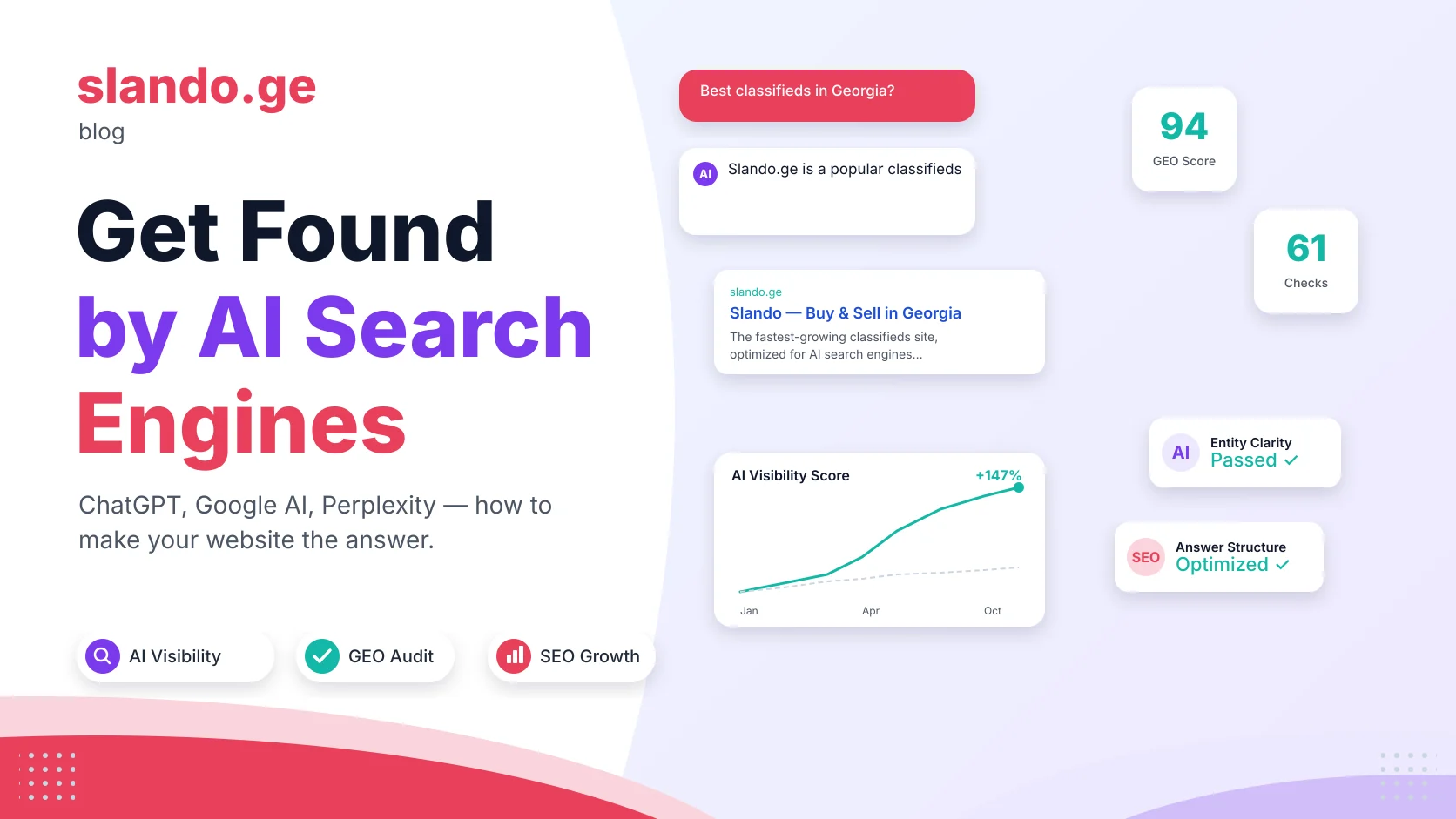
You Google something simple — “best classifieds in Georgia” or “where to sell used furniture in Tbilisi” — and instead of ten blue links, you get a paragraph. An AI-generated answer. It cites a couple of sources, maybe links to one or two sites, and most people never scroll past it.
This is not a prediction. This is how search works right now, in October 2026.
Google’s AI Overviews sit above organic results for roughly 40% of informational queries. ChatGPT’s search mode handles millions of daily lookups. Perplexity gives full sourced answers without any traditional results page at all. If your website isn’t the kind of source these systems pull from, you’re invisible to a growing share of your audience — even if your traditional SEO is fine.
We noticed this at Slando earlier this year. Our Google rankings were decent. Traffic was okay. But we weren’t showing up in any AI-generated answers for queries that should have been ours. People were asking ChatGPT where to buy and sell things in Georgia, and the answers mentioned everything except us.
So we started learning about what’s now called GEO — Generative Engine Optimization. Here’s what we found and what actually worked.
What is GEO and why it matters now
GEO stands for Generative Engine Optimization. It’s the practice of making your website a preferred source for AI systems that generate answers — ChatGPT, Google AI Overview, Perplexity, Gemini, Bing Copilot, and others.
Traditional SEO optimizes for ranking algorithms. GEO optimizes for something different: being the source an AI model chooses to cite when constructing a response. The mechanics are related but not identical.
AI systems don’t just look at keywords and backlinks. They evaluate whether your content actually answers questions clearly, whether your site is structured in a way they can parse, and whether you look like a trustworthy, authoritative source on the topic.
If your content is buried in JavaScript that crawlers can’t render, or your pages don’t clearly state what your business does, or your answers are hidden behind walls of marketing copy — AI engines skip you. They have plenty of other sources to choose from.
The five pillars of AI search visibility
After months of testing and iteration, we’ve found that AI visibility comes down to five areas. Miss any one of them and you’re leaving citations on the table.
1. Crawl access
This is the foundation. If AI crawlers can’t read your pages, nothing else matters.
Most sites block crawlers accidentally. A stray Disallow in robots.txt, aggressive rate limiting, content loaded only via client-side JavaScript, pages behind login walls — all of these are silent killers.
Check your robots.txt for GPTBot, Google-Extended, PerplexityBot, and ClaudeBot. Unless you have a specific reason to block them, allow access. Make sure your key pages render meaningful HTML even without JavaScript execution — most AI crawlers don’t run your React app.
2. Entity clarity
AI systems need to understand what you are. Not vaguely, not eventually — immediately.
Your homepage, about page, and key landing pages should state clearly: what your business does, where it operates, who it serves. Use schema.org markup — especially Organization, LocalBusiness, or WebSite — with accurate, specific information.
We added structured data to Slando that explicitly states we’re a classifieds marketplace operating in Georgia, serving Tbilisi and Batumi. Simple change, big impact. ChatGPT started citing us within weeks.
3. Answer-first content structure
This is the biggest shift from traditional SEO content.
Old-school SEO taught you to write long introductions, build up context, use the keyword naturally throughout a 2,000-word piece. AI engines don’t care about any of that. They want the answer in the first paragraph, then the supporting detail after.
If someone asks “where to sell used furniture in Tbilisi,” and your page starts with three paragraphs about the history of classifieds before mentioning that you’re a classifieds site — you lose. The AI grabs the site that puts the answer first.
Structure your content with the answer at the top, details and context below. Use clear headers that match common questions. Write paragraphs that can stand alone as complete answers.
4. Prompt coverage
People ask AI engines specific questions. If your content doesn’t address those specific questions, you won’t be cited.
This isn’t about stuffing keywords. It’s about actually covering the topics people ask about in your niche. Research what questions people are typing into ChatGPT about your industry. Then make sure your site has clear, direct answers to those questions — on pages that are crawlable and well-structured.
For Slando, this meant creating content that directly answered: “Where to buy used items in Georgia?”, “What’s the best alternative to OLX in Tbilisi?”, “How to sell furniture in Batumi?” — questions we knew people were asking, but that we’d never explicitly targeted.
5. Technical hygiene
The small stuff that’s easy to ignore and expensive to leave broken.
Fast load times, proper SSL, clean URL structures, no broken internal links, valid HTML, proper canonical tags, mobile-friendly layout. None of this is new, but AI systems weigh technical quality more heavily than traditional Google ranking did. A technically messy site is a risky source to cite.
How we used SearchBind to audit and fix our site
We could have tried to check all of this manually. In theory, you can go through your robots.txt, review your schema markup, audit your content structure, and test your technical setup one piece at a time.
In practice, that takes weeks and you’ll miss things. We missed things for months before we found SearchBind.
SearchBind runs 61 automated checks across all five areas — crawl access, entity clarity, answer-first structure, prompt coverage, and technical hygiene. You get a score and a prioritized list of what to fix first.
What made it useful for us wasn’t just the audit itself. It was the prioritization. We had dozens of issues, but SearchBind ranked them by impact, so we knew to fix our robots.txt and schema markup before worrying about secondary content pages.
The paid report goes deeper — it generates actual code snippets for your fixes and drafts content suggestions. For a team our size, that saved us from hiring an SEO consultant who’d take three weeks to deliver what SearchBind produced in a few minutes.
If you want to see where your own site stands, run the free audit. It takes about two minutes and you’ll know immediately whether AI engines can even find your content.
What changed for Slando after we optimized
The results weren’t instant. AI visibility builds over weeks, not days. But within about two months of systematically working through the SearchBind audit fixes, we started seeing real changes.
Slando now appears in ChatGPT responses for Georgian classifieds-related queries. We show up in Perplexity answers. Google’s AI Overview cites us for local buying and selling questions. That’s traffic we simply didn’t have access to before — people who never would have scrolled to our organic search result because the AI answer already told them what they needed.
Our organic traffic from AI-referred sources has grown significantly this year. We can’t attribute all of that to GEO work alone — we’ve also been improving the product itself. But the timing lines up clearly: we started the optimization, and within weeks, AI engines started recommending us.
The key insight is that GEO isn’t separate from SEO. It builds on it. Good structured data helps both Google’s traditional algorithm and its AI Overview. Clear, answer-first content ranks better in regular search AND gets cited by ChatGPT. Fast, clean, crawlable pages work for everything.
The practical checklist
If you want to start improving your AI search visibility today, here’s the short version:
Immediate wins (do this week):
- Check your robots.txt — make sure you’re not blocking AI crawlers
- Add or fix your schema.org Organization/LocalBusiness markup
- Verify your key pages render meaningful content without JavaScript
Medium-term (this month):
- Rewrite your main landing pages with the answer in the first paragraph
- Research and list the top 20 questions people ask AI about your industry
- Create or update pages that directly answer those questions
- Fix broken links, slow pages, and missing canonical tags
Ongoing:
- Monitor which queries AI engines cite you for (Google Search Console shows some of this)
- Run a SearchBind audit periodically to catch regressions
- Update your content when your product or market changes — stale content gets dropped from AI answers fast
The bottom line
AI search isn’t replacing traditional search — it’s sitting on top of it and intercepting the users who would have clicked your link. If you’re not optimizing for it, you’re giving that traffic to whoever is.
The good news: most of your competitors haven’t started yet. The sites that move now get an outsized advantage because AI engines are actively looking for good sources to cite, and the bar is currently low. A well-structured, clearly written, crawlable site stands out right now in a way it won’t two years from now when everyone catches up.
Start with the audit. Fix the obvious things. Then build from there. That’s what we did, and it’s working.